Wednesday, May 16, 2012
A Pic A Day: Sketch of an atrium

Monday, May 14, 2012
Sunday, May 13, 2012
A Pic A Day: Painting on the wall

Saturday, May 12, 2012
Photoblog: starting A Pic A Day

Wednesday, April 18, 2012
Troubles with 'The Tiger's Wife'
First thing first - the story: it's set in an unnamed country, which can't be anything else than now-defunct Yugoslavia. It's told by a young doctor Natalia, who is telling the story of her beloved grandfather, who passed away, and whose life was deeply influenced by two myths - the one about the Tiger's wife and the other about the deathless man.
The book plays on the superstition of the people who live there, portraying the whole area as backward and undeveloped. Admittedly, parts of the old country were just that uncivilized, but the place in whole was much more modern than what you'd feel from the book. The storytelling is smooth and masterful, for someone so young. The story not so much.
My problems start with technicalities - I listened to the audiobook, and the readers managed to mangle all the local names and expressions to the point that it got extremely annoying. I had to take a few days break on several occasions, before I could go on.
The fact that the author changed/made up the names of towns made it even worse. Why making up a name for something that's so obviously recognizable? Like 'Sarabor' for example, which in the book has combined attributes of Sarajevo and Mostar (both Bosnia-Hercegovinian towns were the scenes of monstrous atrocities during the war).
Another thing - having been through that war myself, the unapologetic stand of Ms Obreht irks me to the point of madness. Obreht portrays war she obviously never experienced as a conflict of equally guilty sides. Description of suffering in the war-torn "City," which can only be Belgrade, seems exaggerated. The mythical elements, which carry the main weight of the story, are anticlimactic, too long and too slow. It had a promise of a story a grandma would tell on a wintery night with a cup of warm milk. Instead, it turned into a dragging witch-tale.
And so, here is my problem: the story, and the area is too close to real to be able to take it as fiction or fantasy. And its twisted reality played on my senses of right and wrong. The characters are likable, especially the grandfather, but the surreal elements of deathless man and other superstitions, and the backdrop of the war made it impossible for me to like the book. Maybe, if I never lived there, I would like it. Maybe, if Tea Obreht lived there, she'd write a different story.
Sunday, March 25, 2012
Around the Bay 30k Race
| Meg "leads" the pack around km 5 |
We won't go into details about the race, let's just say that it was well organized and well ran. The weather gods were smiling on us, the rain stopped early in the morning and we had fresh and sunny day to enjoy.
| Waiting for start |
As soon as we got home Meg asked me to register us for Goodlife Toronto half marathon in May. She's hooked on running!
Friday, March 23, 2012
How the media got broken and how we may (try to) fix it
From the days of early gatherings around the fire with fellow tribesmen, one of the most important aspect of tribal life was--sharing news. Whether the news was about sightings of new herds of animals, which would ensure the tribe's survival through the winter, or about the movement of a hostile tribe, sharing news and being informed increased chances for survival.Of course, we've come a long way from the time of tribal gathering (or we like to think we did), and many things have changed: nowadays the news travels the speed of light, and it can be consumed in many ways. What hasn't changed is that being in possession of a crucial information can still mean survival--political, existential or business survival. What I'm trying to say is--news still matters, probably just as much as before.
Except now in place of a lone messenger, or a group of scouts hunters or warriors, we created the whole media industry. For a while the media people were proud of what they do, followed the code of conduct in which they were supposed to fact-check the information before presenting it to the public, and always kept in mind that the only purpose the media exists is to keep the public informed. Noble idea, right?
So, how did it all got broken? There were several factors, the way I see it. First, the rapid growth of advertising in the media, the money it brought and the influence that comes with it. Where the early newspapers and magazines could survive off subscription and street sales, the lure of money from advertising became too hard to resist. Slowly, printed media switched onto advertising as the main source of income. It was great, they could afford to grow beyond their needs and the golden era of journalism ensued. The reporters travelled the world around many times, stayed in expensive hotels and hired transport to wherever they needed to go. It was good for the news business - the coverage was great from the trustworthy source. The downside was the rise of a star-reporters whose personality threatened to become larger than news they were supposed to report. As their fame grew, they moved to become columnists or hosts of news shows, but that's probably a whole separate topic. Let us go back to the state of the media.
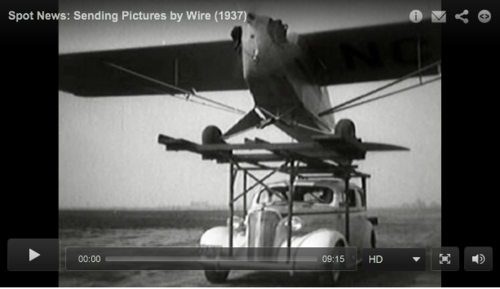
The advance in technology started saturating the advertising market - advertiser spread from print only to the radio, television, and--yes, the Internet, when it came around. At the same time, the ownership of the media outlets changed from journalists who cared about the news to moneymakers who cared about the profit. What we have now is comparable to what had happened with financial sector--the media companies have marketing/sales/advertising teams which are much larger than the editorial teams. What that tells me is that the owners care only HOW to sell, and not WHAT to sell.
With the internet offering advertising targeted narrowly to intended audience, and the public changing from buying their news in print--and the television is slowly feeling the public increasingly reluctant to pay for what it has to offer--to getting it elsewhere, mostly online and for free, print media soon followed by electronic media found itself unable to sustain their large operations.
I know this all was long and yawn-inducing, but it explains what happened next and why we stopped trusting the media to deliver credible news. So--cash strapped media companies increasingly rely on wire agencies to provide the news from the distance. Everybody is covering only their own backyard. The reporters are reporting second-hand from their desks, instead of traveling as before to the scene where the news happened.
The wire agencies on whom we rely to get the news from afar, are also trying to reduce costs. They stopped sending their tried and proven staff reporters on assignments and hire (much cheaper) local freelancers instead. The problem with it is that locals are, by the nature of things, more involved in their local political situation and as such less neutral in their reporting. In plain talk: they tend to take sides and present their preferred side of the story.
To make matters worse, with advance of smart phones and rise of "citizen journalism," everybody is blogging and "reporting" on their own, there's so much not-so-credible information that it's next to impossible to weed out the false from true news. In the newsrooms, the staff is reduced to bare minimum, and the decimated leftover journalists have less and less time to fact-check the reports form the field. Still, the pressure to compete with the web, where speed is everything and 100% accuracy is unimportant, sends the media companies ever more often to report first and fact-check later. We all know the result--growing number of false news is being reported by once-credible news sources, then rebuked. The casualty is our trust in the media.
I know this is very simplified version of a hugely complex problem, but I think I got it right in a nutshell. Here are my thoughts as to what could be done to fix all this.
The main problem is the race for profit. If that's taken out of equation, all that's left to strive for is prestige. And that can be achieved only with high-quality work. Simple, right? The media should go non-profit. It should be financed by independent funds, sheltered from political influence and completely transparent in its finances. How to shelter the funds I haven't quite figure out, except maybe to suggest some international control over it. There would be no advertising, because it wouldn't be needed. Its sole purpose would be to provide credible and accurate information to the public. That way we'd also rid ourselves of the so-called "advertorials"--advertising made to look like editorial news content. And--better yet--there would be no political attack ads.
Imagine if you could tune into a news channel / web site / newspaper and know that all you're getting is a 100% fact-checked news, without bull***? For a journalist it's a dream, maybe unachievable, but worth dreaming.
I'd like to hear what you think about all this. Leave the comments if you like.
Tuesday, March 6, 2012
I thought I was depressed; turns out I'm only introverted
The Quiet Power of Introverts
This is going to be personal, to a point. But, bear with me, it will make sense at the end.
Have you ever come across someone shamelessly boasting about his talents and experience? Some people are so good at it, they climb the ladder based on nothing else but self-promotion. All you need to do is have boundless self-confidence and enough yapping talent to convince the others around you, especially those higher up the food chain, that you are what you say you are.
I was brought up in a society and environment where the saying goes "self-promotion is worthless" (loosely translated), meaning one is supposed to show his true worth with his work, not his words. True to the old wisdom, I found my niche and built my reputation without having to advertise it. But then I moved to Canada. With about 15 years experience as photojournalist, I thought it'd be easy to find work. Yet, on my first job in Calgary, an editor told me that I should be more assertive, that I'm too quiet. And I tried. I competed with lesser photographers, who were more verbal. While I could outdo them with work, they've always outdone me in the newsroom. They moved up, I stayed put. Imagine the hit my self-confidence took!
For a long while I thought I was discriminated against as an immigrant. I thought the Canadian-born were getting the chance, while I, a foreigner, will always stay on the sidelines. Typical immigrant's story, right? I thought so too, until a few weeks ago, when I started reading a book that turned this whole perception upside down. It's called "Quiet: The Power of Introverts in a World That Can't Stop Talking" by Susan Cain.
Did you know that one third of the global population are introverts? That is not a derogative - it's a personality trade. They (we!) are people highly sensitive to the outside stimuli and overstimulation; the ones who prefer peace and quiet over loud and busy; the ones who'd rather have a serious conversation with one person, than entertain a crowd with small talk and trivial jokes. There are whole civilizations based on preferences toward introverts or extroverts. Asian society, at least until recent wave of westernization, valued quiet thoughtful types, who were considered wise and studious. Western Europe and North America are the kingdoms of extroverts - the outspoken, the loud, the good presenters, the self-promoters. They are the risk takers, the leaders, and sometimes the troublemakers. The introverts in the West are the thinkers, the creators. Some famous introverts are Steve Wozniak, who started the whole personal computer revolution from the quiet of his solitary home workroom, Eleanor Roosevelt, a U.S. humanitarian and diplomat who had to fight her shyness to do her work, Albert Einstein who preferred his formulas to his peers.
The book is full of scientific and scholarly studies explaining why is it so that I hate confrontations of any kind, that I'm so distracted by the din of the open office space, its constant buzz and rings of telephones, to the point that it cuts my productivity by half. It also explains how some of my colleagues blabbered their way to promotions and why it worked in the environment which values extroverts and considers quiet types backward, less intelligent and slow.
So, if you find it difficult to talk loud at a party, to hold empty conversations, and prefer to be on your own reading a book, or with one good friend talking about the essence of life - don't worry, you're not depressed, neither are you dumb or weird. Welcome to my third of the world's best - the creative, the inventors, the artists, the thinkers! Without us, conversation would be a shouting contest, with the loudest ideas prevailing. Without us, our extroverted friends would be deprived of the sound advice; the books would be fewer, the innovation slower; the world would be more chaotic. We are the quiet power behind the noise.
Monday, January 2, 2012
How we ran into the New Year - literally!
Music from different parties was mixing together in a cheerful cacophony over our heads. The word spread like fire—from all sides people dressed to party poured out on terraces, balconies and windows. Down at the ground level they stepped out in the alley, keeping to the side, giving us space. They streamed from the pub in the alley, from the restaurant with the terrace, from a gym. It seemed that every shop in Liberty Village held a New Year’s party, and now curiosity drew people out to see what is going on with these two hundred party-goers dressed as fairies, angels, clowns, cartoon characters, and mostly—as runners.
Meg was standing next to me in her pink running jacket, with outrageous-blue feather-scarf. There was a headlight strapped on her forehead, and a blinking light on her ankle. Around us runners of all kind, age and size shimmered with blinking lights and mismatched loud colors of their outfits.
Then sparking sticks were lit at the start line, and the countdown started, shyly at first 10...9...8...then the voices from everywhere picked up...7...6...5...the spectators chiming in, turning their backs on their own parties and joining our crazy countdown...4...3...2...1...HAPPY NEW YEAR!
There was barely time for a quick kiss, Meg and I wishing something to each other, our voices drowned in the tumultuous cheer of the group, and we were off to the first-ever midnight 5k race in Canada (or so we were told). The course itself was dark, with some muddy patches, but the mood was so festive that no mud could tarnish it. On a stretch heading straight toward the CN Tower, Toronto’s landmark, the organizer surprised us with fireworks, sending flowers of fire right above the tower into the new year’s sky.
Although we decided when we registered that we were not going to race, the excitement pushed us faster than intended. I stayed with Meg and she made it in just over 26 minutes. Considering that we were NOT racing, that was fast. We finished with the first 50 runners.
| After race with medals |
Along the way spectators and volunteers wished us happy new year, and we laughed and shouted our wishes back. Back at the gym the party was in full blast. We changed—well, some did—into dry clothes and wiggled on the dance floor with a sandwich in one hand and a drink in the other. This was the best spent New Year’s eve in a long time.
In the race kit, along with the race number which oddly had our LAST names printed on, instead of first, we got the usual number of swag items - flyers for other races, chips, candies, Red Bull, and—a bottle of Prosecco each! Now, which race do you know to do that? And the finisher’s medal at the end was equally inspired, as you can see in the photos.
If you find yourself in Toronto for the New Year’s party next year, you may consider active partying at the Toronto Midnite Run. I would highly recommend it.
Thursday, December 15, 2011
Christmas cookies bonanza
![]() |
| Meg with vanilla crescents ready for the oven. |